From Clipboards to Dashboards
Turning Paper-Based Field Operations into a Scalable Digital System
Four multi-site remediation programs moved field data collection, compliance tracking, and audit readiness onto a single mobile hub. Here's how it was built, what it returned, and where the same pattern applies.
4 major programs deployed
~60 digital workflows built
160+ field staff, subcontractors and managers using it
3–5 hours of admin returned per week, per site team
4 of 4 deployments still in production
Everything lived on a clipboard
Across four active remediation programs, field documentation ran entirely on paper. Compliance forms were completed on clipboards and filed in cabinets. Sign-in and sign-out sheets were counted by hand to produce labor hours. Annual physicals, HAZWOPER certifications, client-required training, and equipment calibration were each tracked separately - or tracked in an individual manager's memory.
There was no central place for a worker to find a form, or for a manager to find a record.
The information all existed. It just wasn't usable data.
The process was reactive by design
An expired certification was typically discovered after it expired, when someone pulled the file
Answering "who is on site right now" meant walking to the clipboard — including during an emergency
Workers who forgot to sign out stayed invisible until someone reconciled the sheets by hand
Equipment downtime went untracked, so rental spend on idle equipment went unexamined
Audit preparation ran roughly three working days of locating, scanning, and reviewing paper records
Every paper record was a single point of failure
None of this was a discipline problem. It was a structure problem. Work that isn't captured as structured data can't be automated, reported on, or scaled — and these programs needed to scale across additional sites.
One hub, roughly fifteen workflows, any phone or tablet
A mobile site operations hub became the single landing page for every user on the project. From a phone or tablet in the field, a worker opens the hub and gets every digital form that applies to their role, alongside the emergency information they might need - muster points, fire extinguisher locations, emergency contacts. Each submission is stored as structured data the moment it is sent.
Behind the hub sit roughly fifteen forms and workflows per program, each designed around the underlying compliance requirement and the field user rather than around the paper form it replaced. Automated workflows handle compliance monitoring, so an alert fires before a deadline rather than after it.
The architecture was deliberately built to be copied and configured. A new project starts from the established solution and adjusts it rather than rebuilding from zero. Built on Smartsheet - forms, dashboards, reports, and automated workflows.
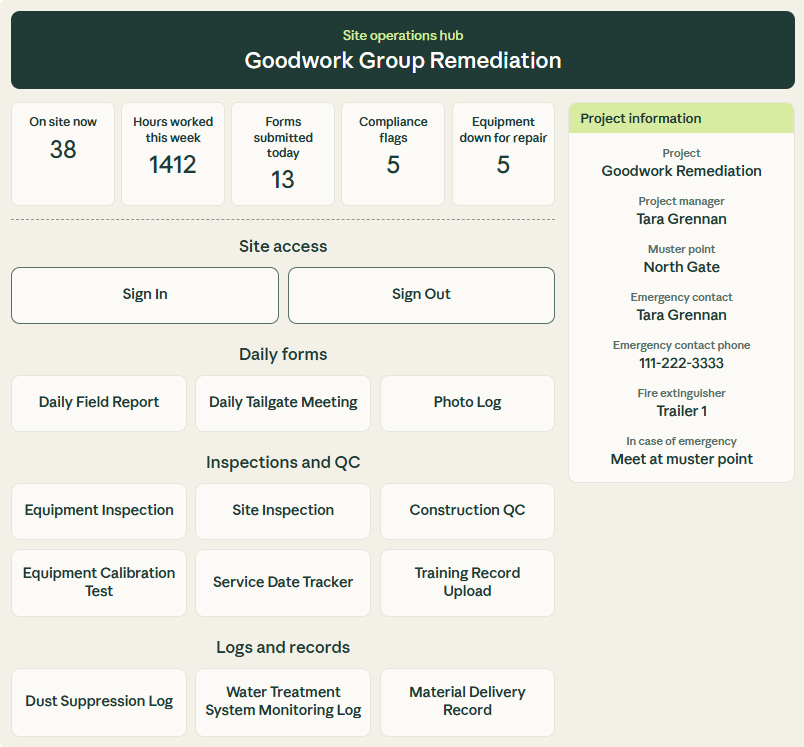
Illustrative rebuild
What leadership could finally see
Labor. Hours by employee, subcontractor, labor group, week, or month - without anyone counting a sheet.
Presence and safety. Who is on site now, who was on site during an incident, who failed to sign out.
Equipment. What needs repair, how many days a unit has been down, calibration pass/fail results, and what calibration is coming due.
Compliance. Status by person, with upcoming expirations for physicals, HAZWOPER, site training, and client-required credentials surfaced weeks ahead of the deadline.
History. Searchable, retrievable records available without opening a file cabinet.
What changed
Compliance management moved from reactive review to proactive alerting. Reporting moved from manual reconstruction to near-real-time visibility. Audit readiness stopped being an event that consumed days and became a condition the system maintained continuously.
Each site leadership team recovered roughly three to five hours per week of recurring administrative work. Audit preparation, previously a multi-day manual retrieval effort, became a filtered report.
The clearest signal is longevity: all four deployments remain in daily production use. The solution became part of how the sites operate, rather than a pilot that quietly lapsed.
Why building beat buying
The client faced real cost constraints, and the dedicated field-management products on the market were significantly more expensive - while still not delivering the specific workflows and dashboards the programs needed.
Building on the platform the organization already licensed meant no new vendor relationship, no additional licensing tier, no parallel technology stack, and no second system for users to learn. It also meant workflows could change when operations changed, instead of waiting on a product roadmap.
The result combined field forms, compliance management, reporting, and management visibility in one environment - and produced an asset the organization owns and can redeploy.
The part that decides whether it works
Don't pave the cowpath. Digitizing a paper form as-is produces an inefficient process that happens to be electronic. Every workflow had to be redesigned around what the data needed to do downstream, because what you capture as a structured field determines what you can ever report on.
Adoption is the other half. The system had to work on day one for paper-native crews and for subcontractors who don't work for you, across a wide range of technical comfort. A system nobody opens produces no data, and a system with no data produces no dashboards.
Where this pattern applies
The setting here was remediation and construction. The underlying problem is not industry-specific. This pattern applies wherever:
Work happens in the field but reporting happens at a desk
Compliance obligations carry expiration dates that someone tracks by hand
Documentation is collected to satisfy audits rather than to run the operation
The same process is rebuilt from scratch at every new site, project, or location
The organization already pays for a capable platform that's being used as a spreadsheet
Company data is input and needs to be tracked
Have a version of this problem?
I build systems the people doing the work will actually use. If any of that list describes your operation, I'd like to hear about it.
Tara Grennan - tara.grennan@goodworkgrp.com